MAPGuideⓇ
Equitable Access Toolkit
Approaches to Intellectual Property Rights Management in Funding Agreements
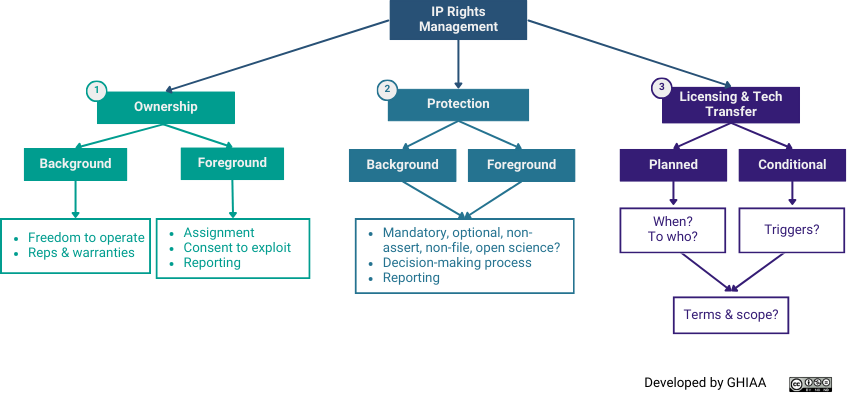
The R&D activities undertaken within the scope of a funding agreement often require the use of the funded partner’s existing intellectual property rights (“background IP”) and result in the generation of new intellectual property rights (“foreground IP”). Agreement provisions related to the management of these IP rights can play an important role in facilitating access to funded products and technologies. In particular, these provisions should address:
Who owns the background and foreground IP related to the funded project
If and how IP will be protected through patent filing and enforcement activities
If and how IP will be shared through license and technology transfer agreements
As outlined in the diagram below, there are different potential approaches to each of these elements.
1. IP Ownership
Provisions related to IP ownership need to consider the background and foreground IP relevant to a project.
Background IP
The most common approach found in funding agreements is that the funded partner retains ownership of the IP (sometimes referred to as “technology“) that it owns prior to the agreement effective date, as well as IP that it develops or acquires independently of a funded project during the term of the funding agreement (sometimes referred to as “sideground IP“).
An additional consideration for background IP is confirmation that the funded partner has the right to use any third party IP that is needed to develop and commercialize a funded product (also referred to as “freedom to operate”).
Some funding agreements require specific non-infringement and/or freedom to operate representations from the funded partner or make the release of future funding payments conditional on the funded partner securing appropriate rights to use the third party IP.
Foreground IP
As with background IP, ownership of foreground IP (also referred to as “project IP”, or “project technology”) usually remains with the funded partner (the IP inventor). However, some agreements may provide for assignment of foreground IP to the funder under certain conditions. Examples of this approach can be found in some U.S. government funding agreements in line with U.S. federal regulations.
Other considerations related to foreground IP ownership may include:
-
- Requirements for IP that is created by or with subcontractors/sub-awardees under the funding agreement to be assigned to the funded partner. This assignment can be important if a funder seeks to exercise enforcement and continuity rights;
-
- Requirements for the funded partner to obtain the funder’s consent prior to exploiting the foreground IP, particularly for for-profit purposes. Such consent requirements may be included to ensure that relevant funding agreement provisions flow through into the provisions of any license agreements, to identify any commercial benefits that should be shared with the funder, and/or to provide an opportunity for the establishment of more detailed access commitments for the further development of the funded IP; and
-
- Notification requirements for the generation of new project-related IP as part of the funded partner’s reporting obligations.
Examples from the MAPGuide
Background IP
Developer retains ownership of background: [Developer] shall retain ownership of its intellectual property existing as of the Effective Date, or developed or acquired independently of the Project during the term of this Agreement (“[Developer] Background IP”) and licenses to third party intellectual property secured prior to the Effective Date [***] (“Third Party Background IP” which, along with [Developer] Background IP, shall be referred to as “Background IP”), and nothing in this Agreement shall be deemed to assign any ownership in, or grant a license to, [Funder] with respect to such Background IP; except for the limited license rights otherwise expressly provided herein for the Public Health License.
Source: taken from a development funding agreement for up to USD $384 million between CEPI (Funder) and Novavax (Developer). Partner types: non-profit funder, industry; Product type: COVID-19 vaccine; Development stage at signature: phase I clinical trials. Read in context.
To [Developer]’s knowledge, [Developer] owns or has and will own or have a valid license to all Essential Background Technology necessary for the development of the [product] in accordance with the terms of this Agreement and the Grant Agreement. To [Developer]’s knowledge as of the date hereof, the manufacture or sale of the [product] by [Developer] in accordance with this Agreement does not infringe any intellectual property rights of a third party to which [Developer] does not hold a valid license. Except to the extent expressly provided in this Agreement and the Grant Agreement, nothing in this Agreement shall be construed to confer any ownership interest, license or other rights upon the [Funder] or any of its Affiliates or any [Funder]-supported entity by implication, estoppel or otherwise as to any technology, intellectual property rights, products or materials of [Developer] or any other entity.
Related definitions: “Essential Background Technology” means Background Technology that is: (a) owned, controlled, or developed by You, or in-licensed with the right to sublicense; and (b) either incorporated into a Funded Development or reasonably required to exercise the license to a Funded Development.
Source: taken from a global access and price commitments agreement between the Gates Foundation (Funder) and Icosavax (Developer), signed in connection with a USD $10 million grant agreement between the parties. Partner types: philanthropic funder, industry; Product type: COVID-19 vaccine; Development stage at signature: preclinical. Read in context.
On the Effective Date, the Company has conducted commercially reasonable due diligence with respect to the Project Agreements, including intellectual property and freedom to operate analyses related to the Project Agreements. To the Company’s knowledge on the Effective Date it owns or possesses sufficient legal rights to all trademarks, service marks, tradenames, copyrights, trade secrets, licenses, information and proprietary rights and processes and all patents necessary for its current business without any conflict with, or infringement of, the rights of others. On the Effective Date, the Company has not received any communications alleging that the Company has violated or, by conducting its business, would violate any of the patents, trademarks, service marks, tradenames, copyrights, trade secrets or other proprietary rights or processes of any other Person.
Source: taken from a global access commitments agreement between the Gates Foundation (Funder) and CureVac (Developer) signed in relation to an investment in CureVac by the Foundation. Partner types: philanthropic funder, industry; Product type: vaccines and drugs for target diseases using mRNA platform technology; Development stage at signature: preclinical. Read in context.
It will be each Partner’s responsibility to ensure that it has obtained all necessary licences and consents to perform the Project. [Funder] shall be entitled to retain funding or to condition any funding unless and until each Partner has reasonably satisfied [Funder] that it has obtained all of the third party licences reasonably required to perform the Project and to supply the Project Vaccine. In the event that a Partner is bound by, or is to be bound by, certain obligations to any third party that holds IP rights necessary to develop and commercialize the Project Vaccine (“Third Party Collaborators”), such Partner shall (i) notify [Funder] in writing of the identity of such Third Party Collaborators as well as such Partner’s obligations in relation to them, (ii) use reasonable endeavours to facilitate the necessary arrangements between [Funder] and Third Party Collaborators in the event the Public Health License is triggered under Clause [x], and (iii) use reasonable endeavours to secure all IP rights from Third Party Collaborators as required for a technology transfer under Clause [x].
Source: taken from a USD $34.8 million funding agreement between CEPI (Funder) and the University of Oxford and Barinthus Biotherapeutics (Developers). Partner types: non-profit funder, industry/academic institution; Product type: MERS vaccine; Development stage at signature: early stage development. Read in context.
Foreground IP
Unless provided otherwise in a specific Project Agreement (as defined below), the Parties agree that any results, information, invention, patent right and other intellectual property right and any know how generated by or on behalf of the [Developer] with respect to the Platform Technology and/or the Funded Developments shall be owned by the [Developer] and the [Developer] shall be responsible, in its sole discretion, to file, prosecute, maintain and defend such intellectual property rights.
Source: taken from a global access commitments agreement between the Gates Foundation (Funder) and CureVac (Developer) signed in relation to an investment in CureVac by the Foundation. Partner types: philanthropic funder, industry; Product type: vaccines and drugs for target diseases using mRNA platform technology; Development stage at signature: preclinical. Read in context.
[Developer]’s obligations.
(1) The [Developer] shall disclose in writing each subject invention to the Contracting Officer within 2 months after the inventor discloses it in writing to [Developer] personnel responsible for patent matters. The disclosure shall identify the inventor(s) and this contract under which the subject invention was made. It shall be sufficiently complete in technical detail to convey a clear understanding of the subject invention. The disclosure shall also identify any publication, on sale (i.e., sale or offer for sale), or public use of the subject invention, or whether a manuscript describing the subject invention has been submitted for publication and, if so, whether it has been accepted for publication. In addition, after disclosure to the agency, the [Developer] shall promptly notify the Contracting Officer of the acceptance of any manuscript describing the subject invention for publication and any on sale or public use.
(2) The [Developer] shall elect in writing whether or not to retain ownership of any subject invention by notifying the Contracting Officer within 2 years of disclosure to the agency. However, in any case where publication, on sale, or public use has initiated the 1-year statutory period during which valid patent protection can be obtained in the United States, the period for election of title may be shortened by the agency to a date that is no more than 60 days prior to the end of the statutory period.
[…]
[Funder]’s Rights.
(1) Ownership. The [Developer] shall assign to the agency, on written request, title to any subject invention-
(i) If the [Developer] fails to disclose or elect ownership to the subject invention within the times specified [above], or elects not to retain ownership; provided, that the agency may request title only within 60 days after learning of the [Developer]’s failure to disclose or elect within the specified times.
[…]
Source: taken from a fixed price development contract between the U.S. Government (Funder) and Moderna (Developer). Partner types: government funder, industry; Product type: COVID-19 vaccine; Development stage at signature: phase I clinical trials. Read in context. Read in context.
The [Developer] shall use its best commercial efforts to include provisions in its contracts with its subcontractors performing service(s) requiring the subcontractors to assign to the [Developer] all Project IP Rights.
Source: taken from the CARB-X template funding agreement. Partner types: non-profit funder, industry/academic institution/PDP; Product type: antibacterial products (antibiotics, preventatives, rapid diagnostics); Development stage at signature: discovery through to phase 1 clinical trial. Read in context.
Except as expressly provided below and to the extent feasible and legally possible, all Project Technology shall be either the property of the Partner or be licensed from Third Parties, and any patents in respect of Project Technology shall be applied for in the name of the Partner. The Partner shall procure that:
- any Affiliate, Third Party collaborator, Third Party funder, co-owner or Sub-Contractor of the Partner shall assign all its right, title and interest in Project Technology promptly to the Partner to the extent Controlled and shall retain rights in the same to the extent stipulated under the agreement between Partner and Sub-Contractor
- it shall have in place contracts with those working on or funding all Work Packages of the Project to ensure that the Project Technology shall vest in the Partner and not with any members of staff individually. Where by local applicable law such rights do vest in individual members of staff, the Partner shall ensure that it has all rights to take assignment of all right title and interest in the same and the Partner shall bear the costs of any necessary contribution to such individual or other costs of assignment; and
where a Partner has appointed NIH or another government entity or university as a Third Party Sub-Contractor and such government entity is required by law or otherwise to retain ownership of [Developer] Results they have generated in the conduct of activities described in a Work Package Statement (“Government Results”), the Partner shall ensure that the government entity provides Partner with sufficient rights and license (including via option to license where the government entity is unable to provide licenses in advance of generation) to any such Government Results in order to enable the Partner or [Funder] to further Develop the Platform and Develop and Manufacture Project Vaccines and Manufacture Products in accordance with the terms and conditions of this Agreement.
Source: taken from a USD $34 million funding agreement between CEPI (Funder) and CureVac (Developer). Partner types: philanthropic funder, industry; Product type: mRNA platform technology; Development stage at signature: preclinical. Read in context.
Prior to any member of the [Developer] Group (whether itself or through any other member of the [Developer] Group, or by granting a license or in collaboration with any Third Party) (the “Exploiting Party”), commencing the Development and/or Exploitation Of any Programme Intellectual Property and/or Products both inside and outside the Field, [Developer] or the relevant the member of the [Developer] Group shall obtain the prior written consent of the [Funder] to such Development and Exploitation by sending written notice to the [Funder] and the following information:
- reasonable details of the relevant Programme Intellectual Property, the Products and the activity proposed;
- details of whether the proposed Exploitation will be on a For-Profit and/or Not-For-Profit Basis; and
- if applicable, amounts of any milestones payments and royalties that would be payable to the [Funder] pursuant to Schedule [x] [revenue sharing terms] and any other applicable terms.
Where Exploitation is to be on a For-Profit Basis, the grant of the [Funder]’s consent pursuant to Clause [x] shall be conditional on the payments to the [Funder] of amounts calculated pursuant to Schedule [x], and the [Funder] and [Developer] agreeing an appropriate share of any revenue payable to the [Funder] pursuant to Schedule [x].
Related definitions: “Exploit” means exploitation activities after completion of the Programme including obtaining Marketing Approval and the commercialisation, licensing, marketing, distribution and sales of Programme Intellectual Property and any Products utilising the Programme Intellectual Property including on a Not-for-Profit Basis and “Exploited” and “Exploitation” shall be construed accordingly.
Source: taken from a USD $5.4 million grant agreement between the Wellcome Trust (Funder) and PTC Therapeutics (Developer). Partner types: philanthropic funder, industry; Product type: cancer therapeutic; Development stage at signature: drug discovery. Read in context.
In order to ensure that any proposed exploitation is in accordance with the FUNDER’s Mission, the Partner shall obtain FUNDER’s prior written consent before exploiting any of the Foreground Intellectual Property or any Product. FUNDER shall only withhold its consent to exploitation:
- where the proposed exploitation in the Field in the Affected Territory is inconsistent with the FUNDER Mission, the FUNDER Policies or the provisions of this Clause;
- FUNDER has material concerns about the capability, solvency or reputation of any third party who is proposed to be involved in the exploitation; or
- the Partner plans to transfer the Foreground Intellectual Property to a third party but does not also intend to transfer to the third party the Partner’s obligations to FUNDER under this Agreement in such a way that FUNDER could enforce such obligations directly against such third party.
Source: taken from an anonymised product development funding agreement. Read in context.
The Awardee will: a. notify the JMAG as Project IP is created, discovered or made; any applications for any rights to Project IP are submitted or are otherwise prosecuted; any application regarding the registration of any Project IP is granted, including the granting of any patent or trade mark, as part of its regular [product development] reports.
Source: taken from CEPI’s (Funder) template funding agreement for its CfP3(i) funding call, supported by the European Commission’s Horizon 2020 programme. Partner types: non-profit funder; Product type: Rift Valley Fever and Chikungunya vaccines; Development stage at signature: early- through to late-stage clinical development. Read in context.
2. IP Protection
The protection of intellectual property generally refers to the filing and enforcement of patents to protect existing and newly created inventions related to a funded project.
Patent rights are a potentially valuable asset that can have an impact on a product developers’ ability to raise future funding and attract future development partners. It is also important to consider the need to protect funded IP to guard against the possibility of patent filings by other parties which may have a detrimental impact on the access objectives of a funded project. For these reasons, funding agreements may include a specific requirement for a funded partner to file, maintain and enforce patents for project-related IP, however these actions are more commonly at the funded partner’s discretion (often phrased as a “right but not obligation”).
Where patent filing is at the option of the funded partner, the funder may wish to retain rights to: (i) review and comment on the patenting strategy for funded IP; (ii) seek patent protection for funded IP if the funded partner chooses not to do so; and/or (iii) request periodic updates on the funded partner’s patent filing activities.
In some cases, the equitable access objectives of a funded project may be better served through commitments to open science, minimally defensive patent strategies, or non-filing or non-enforcement of patents in certain territories. For early-stage R&D, these approaches can accelerate innovation by reducing barriers to the rapid sharing of data and materials. For later-stage development, non-filing or non-enforcement of patents may allow other organizations to manufacture and commercialize the product, potentially facilitating increased availability and affordability.
A potential alternative approach to including specific obligations related to IP protection in a funding agreement, is to require establishment of an appropriate IP rights management strategy as part of an evolving access plan attached to the agreement.
Examples from the MAPGuide
Background Technology. Partner shall have the right but not the obligation to prosecute, maintain and defend the patent rights which are part of the Background Technology.
Project Technology. The Partner has the rights but no obligation to take responsibility for seeking and maintaining protection for Project Technology at its sole cost, including the filing, prosecution, maintenance, extension and defense of any patent applications or patents in respect of Project Technology.
Source: taken from a USD $34 million funding agreement between CEPI (Funder) and CureVac (Developer). Partner types: philanthropic funder, industry; Product type: mRNA platform technology; Development stage at signature: preclinical. Read in context.
It is the responsibility of the [Developer] to take steps to protect any IP rights which may be identified. However, the Host Institution shall not be obliged to protect IP where, in the reasonable opinion of both [Funder] and the [Developer], there is insufficient commercial justification to do so.
If the [Developer] decides not to protect or exploit IP, [Funder] shall have the right, but not a duty, to protect, manage and exploit such IP. The Host Institution must ensure that its employees, students and any third party acting on its behalf do all acts required to assist [Funder] in such protection, management and exploitation.
Source: taken from the standard grant terms and conditions for GOSH Charity (Funder). Read in context. Partner types: philanthropic funder, academic institution/non-profit research institution; Product type: products for prevention, diagnosis, prognosis, or treatment of rare or complex paediatric diseases; Development stage at signature: early stage R&D. Read in context.
Any and all decisions relating to the filing, prosecution and maintenance of patents that disclose and claim inventions that are Project IPRs, shall be at the discretion of [Developer]. The [Funder] shall, however, during the course of this Agreement have the right to review and provide comments on patent filing strategy – including whether Project IPR should be the subject of a patent application or should be dedicated to the public domain – and all draft patent applications.
Source: taken from a USD $2.5 million funding agreement between the Gates Foundation (Funder) and CureVac (Developer). Partner types: philanthropic funder, industry; Product type: RNA rotavirus vaccine; Development stage at signature: preclinical. Read in context.
No Party shall enforce their rights under any Programme Intellectual Property for infringement or potential infringement by:
(a) any organisation operating on a Not for Profit Basis or any charitable organisation which is conducting non-commercially sponsored research; and/or
(b) any person carrying out non-commercially sponsored research on behalf of any organisation operating on a Not for Profit basis or any charitable organisation.
Source: taken from a USD $5.4 million grant agreement between the Wellcome Trust (Funder) and PTC Therapeutics (Developer). Partner types: philanthropic funder, industry; Product type: cancer therapeutic; Development stage at signature: drug discovery. Read in context
If […] a third party making, using, offering for sale, selling, or importing [API] that is solely used to produce [Product] for [Field] infringes or allegedly infringes a claim of a patent or patent application owned or licensed by the [Developer] that is necessary to make such [API] […] the [Developer] covenants to the [Funder] that it will not seek to enforce (whether via an injunction, a declaratory relief action, a claim for damages, or otherwise) such patent or patent application against such third party’s making, using, offering for sale, selling, or importation of such [API].
Source: taken from a letter agreement between the Gates Foundation (Funder) and Amyris (Developer) signed in connection with a USD $5 million stock purchase by the Gates Foundation. Partner types: philanthropic funder, industry; Product type: input material for malaria therapeutics (artemisinic acid and amorphadiene for use in artemisinin-based combination therapies (ACTs)); Development stage at signature: licensed product. Read in context.
The Global Access Strategy should address the following concepts with respect to all Funded Developments: […] strategies to secure, manage and allocate intellectual property rights associated with the Funded Developments or Background Technology in a way that ensures Global Access while providing incentives for future potential private sector participation
Source: taken from a USD $9.3 million grant agreement between the Bill & Melinda Gates Foundation (Funder) and Arsanis (Developer). Partner types: philanthropic funder, industry; Product type: RSV mAb; Development stage at signature: preclinical. Read in context.
3. Licensing & Technology Transfer
Some funding agreements provide for the funded partner to grant a license to project-related IP, and potentially undertake technology transfer activities, for the purpose of facilitating equitable access. Agreements may contemplate these activities:
As part of the agreed access commitments and scope of the funded project;
As a potential mechanism for achieving the access commitments under the funded project, subject to further agreement between the funder and funded partner as the project progresses (for example, through an access plan), and good faith negotiations between the funded partner and a potential licensee; and/or
As an enforcement and continuity, or public health emergency response mechanism triggered only if the funded partner cannot or will not fulfil its access obligations under the funding agreement.
When a funded partner agrees to licensing and technology transfer to a third party manufacturer as part of the scope of its access commitments, related provisions in the funding agreement may address:
Selection of a suitable manufacturer
For example, some agreements require identification of LMIC-based manufacturers to support the local or regional manufacturing and supply of the funded product. Other agreements may anticipate the negotiation of a license with an organization such as the Medicines Patent Pool, which would then be responsible for granting sublicenses to suitable manufacturers.
Sources of funding for the licensing and technology transfer activities
Both the funded partner and the third party manufacturer may incur legal, personnel, travel, capital and other costs during the (potentially lengthy) licensing and technology transfer process.
Mechanisms for covering the funded partner’s costs may include through the funding agreement budget, supplementary funding from another funder, in kind contributions from the partner, and/or as part of the payment structure in the license or technology transfer agreement.
Requirements to support manufacturers with preparing for and receiving technology transfer could be considered as part of an end-to-end access roadmap.
The scope of the license/technology transfer agreement
For example, funding agreement provisions may require the pass through of access commitments and other key obligations to third party manufacturers; they may also specify the expected extent of technology transfer commitments and/or the territory in which the manufacturer should be permitted to commercialize the funded product.
Examples from the MAPGuide
Sub-Awardee Obligations. A Sub-Awardee must agree to comply with all of the relevant obligations applicable to Awardee, whether explicitly identified as such or as is reasonable from the nature of the obligation. Each sub-agreement with a Sub-Awardee must:
- be consistent with the Work Package Stream structure as well as the associated milestones and budgets;
- require the same record keeping obligations and provide [Funder] the same access (either directly or indirectly through Awardee) to IPDP and Financial Records (as are applicable to Awardee);
- require compliance with the same laws, policies and procedures as are applicable under these T&Cs;
- be consistent with Awardee’s obligation in this Agreement, including in the sections related to Dissemination and Publication of Project Data (Clause [x]); Dissemination of Project Materials (Clause [x]); Intellectual Property (Clause [x]); Equitable Access (Clause [x]); Sharing of Commercial Benefits (Clause [x]); Preparation for Outbreaks (Clause [x]); the Public Health License (Clause [x]); and Term and Termination (Clause [x]); and
- prohibit the Sub-Awardee from subcontracting its obligations without [Funder]’s consent. Such consent not to be unreasonably withheld, conditioned or delayed.
[…]
To facilitate achievement of the conditions set out in Clauses [equitable access], [Developer] has agreed to transfer its technology to an LMIC manufacturer as outlined in the IPDP. Without limiting [Developer]’s obligations under the IPDP, [Developer] will, within [***] of the signature date of this Agreement, […] sign a Sub-Awardee agreement with an LMIC manufacturer, which Sub-Awardee agreement shall meet the requirements of Clause [sub-awardee obligations] and shall obligate such LMIC manufacturer to manufacture the Product for regular supply in all Non-Traveler’s Market Countries that have a demand for Product and to supply the Product to Non-Traveler’s Market Countries under the conditions of Clause [equitable access].
[…]
As described in the IPDP, Awardee will be transferring technology to two Sub–Awardees ([commercial manufacturer] and an LMIC manufacturer) and the costs of such technology transfers are included in the Project Budget. Awardee will promptly and diligently provide all necessary guidance, information, materials and assistance reasonably required to transfer Awardee’s technology to each such Sub–Awardee as outlined in the IPDP.
Source: taken from a USD $23.4 million funding agreement between CEPI (Funder) and Valneva (Developer). Partner types: philanthropic funder, industry; Product type: Chikungunya vaccine; Development stage at signature: phase 3 clinical trials. Read in context.
The [Developer] will work with the [Funder] to develop (by the time of completion of Phase II clinical trials) and execute a manufacturing and supply plan that will enable to be met the reasonably expected demand in Developing Countries for any Products. […] The manufacturing and supply plan could involve the use of manufacturing partners and support from donors, and the specific level and allocation of funding responsibilities in such plan will be decided as mutually agreed in good faith in writing by the parties based on a fair allocation of the expected benefits between Developing Countries and developed countries. […]
Source: taken from a strategic relationship agreement between the Gates Foundation (Funder) and Arsanis (Developer) signed in connection with an USD $8 million investment by the Foundation. Partner types: philanthropic funder, industry; Product type: neonatal sepsis mAb (staphylococcus aureus); Development stage at signature: discovery. Read in context.
If the [Funder] determines, in consultation with the Progress Review Group, […] that working with a third–party manufacturer (“TPM”) is reasonably necessary to achieve the price and volume commitments described below, the [Developer] will agree to license and transfer the necessary technology and other intellectual property to such TPM (subject to such TPM entering into reasonable agreements with the [Developer] with respect to confidentiality and use of the technology and licenses solely for the purposes contemplated herein) in order to allow the production of Products for the Developing Countries. The [Funder] will be responsible for the reasonable costs payable for the license and technology transfer of the necessary intellectual property to such TPM.
Source: taken from a strategic relationship agreement between the Gates Foundation (Funder) and Arsanis (Developer) signed in connection with an USD $8 million investment by the Foundation. Partner types: philanthropic funder, industry; Product type: neonatal sepsis mAb (staphylococcus aureus); Development stage at signature: discovery. Read in context.
Do plans for potential licensing and technology transfer align with the capacity of third party manufacturers? Is third party funding available to support technology transfer activities?
Will IP protection and licensing strategies be developed as part of an equitable access plan?
How should publication of results or other data sharing requirements align with IP protection considerations?
How can a funder ensure the survival of global access commitments if a funded partner assigns or transfers project-related IP to a third party?
Should the parties be required to notify each other of the creation of foreground IP or activities related to IP protection?
Will a joint steering committee have oversight of the IP protection and or licensing strategy?
This toolkit has been built based on the data in the MAPGuide and the GHIAA team’s experience of negotiating and implementing agreements. We intend that the toolkit will evolve and expand over time based on input from MAPGuide users and availability of new agreements showing examples of alternative approaches. We welcome ongoing constructive dialogue around these materials and encourage you to contact us or fill in our feedback survey to share your thoughts, questions and suggestions.