Provision Language
2. Project Organization and Management
[…]
2.3 Project Organization. The Project will be organized and managed as described in the Team Charter in Annex B. The Project management shall be Awardee’s sole responsibility provided that Awardee shall consult with CEPI concerning the management of the Project to the extent required by the Team Charter and/or this Agreement and will consider CEPI’s comments in good faith. [***] Notwithstanding the foregoing, CEPI shall be entitled to be party to tripartite meetings between CEPI, Awardee and each LMIC Manufacturer [***]
2.4 Joint Monitoring and Advisory Group. The Team Charter establishes a Joint Monitoring and Advisory Group (or “JMAG“) to facilitate communications and interactions between the Parties and any LMIC Manufacturers, as well as review Project activities in terms of timelines and budget. [***]
2.5 The Awardee will:
a. undertake the activities and comply with the obligations described in the Team Charter;
b. participate in the designated activities and meetings of the JMAG;
c. keep accurate, complete and reliable records of activities performed and results arising as a result of the activities set out in the IPDP (“IPDP Records“);
d. maintain the IPDP Records for [***] after the termination or expiry of the Project, or for any longer period as required by law, the CEPI Clinical Trials Policy or Awardee’s own policies;
e. monitor progress of the Project and make IPDP Reports to the JMAG as described in the IPDP;
f. keep the JMAG (until the Equitable Access Group is established in accordance with Clause 16.3 in which case Awardee will inform the Equitable Access Group) informed of its adherence to the Equitable Access Plan and its progress in meeting its objectives;
g. propose amendments to the IPDP and Project Budget to the JMAG, as may be required; however, such amendments may require CEPI approval beyond the JMAG level; and
h. notify CEPI if the Project Lead designated in the IPDP becomes unavailable and designate a replacement reasonably satisfactory to CEPI within [***].
7. Clinical Studies
[…]
7.4 The Awardee will:
[…]
e. establish a data safety monitoring board (DSMB);
f. notify the JMAG in writing immediately following any safety issues or similar events;
[…]
h. subject to the confidentiality provisions contained in clause 24.4, permit a CEPI representative or nominee (except for any matters that should remain blinded to CEPI in the interests of the integrity of the clinical study and except for closed sessions) to: a. attend meetings of the DSMB for the clinical study as an observer (either in person or by electronic means); and b. receive all papers that a member of the TSC (as defined in Clause 7.5a) or DSMB would be entitled to receive.
7.5 In order to support the clinical studies funded by CEPI (whether in whole or in part), the awardee:
a. will establish a trial steering committee (TSC) or any other appropriate clinical oversight setting, as agreed between the Parties; […]
8. Quality Requirements and Responsibilities
[…]
8.3 Quality-related disputes between the parties that are not resolved in the normal course of business shall be brought to the attention of the JMAG in writing. Both Parties shall use all reasonable endeavours to agree to a prompt resolution of the disagreement and agree to work jointly to develop a strategy for such solution. If the quality-related dispute relates to the LMIC Manufacturer, Awardee shall encourage the LMIC Manufacturer to work jointly with CEPI to develop a strategy for solution. The Parties shall record any such resolution in writing.
16. Equitable Access
[…]
16.3 Equitable Access Group. Within [***] of the effective date the parties will establish an Equitable Access Group (the “Equitable Access Group“) that will meet regularly to monitor the progress of, and advance the Awardee’s commitment to, Equitable Access. The LMIC Manufacturer will be a member of the Equitable Access Group and will keep the other members regularly informed of its commitment to Equitable Access. Within [***] of setting up the Equitable Access Group, the Parties will update the Team Charter to describe the organisation and management of the Equitable Access Group.
23. Resolving Differences
23.1 Escalation process. Any question, difference or dispute which may arise concerning the construction, meaning or effect of this Agreement, or concerning the rights or liabilities of the Parties hereunder, or any other matter arising out of or in connection with this Agreement shall first be submitted to the Chief Executive Officer of CEPI and to the Chief Executive Officer of the Awardee (the “Senior Officers“) for resolution (each of whom may call on others to advise them as they see fit). The Senior Officers shall discuss the matter arising in good faith and in a timely manner and endeavour to reach a mutually agreeable solution. If the Parties are unable to resolve such dispute through such negotiations within [***] of such dispute being escalated to the Senior Officers, then in respect of any dispute, controversy or claim the Parties irrevocably submit to arbitration in accordance with Clause 23.2.
23.2 Arbitration. Any disputes to be resolved by binding arbitration pursuant to clause 23 (including any question regarding its existence, validity or termination or this Agreement), shall be referred to and finally resolved by arbitration under the Rules of the London Court of International Arbitration, which Rules are deemed to be incorporated by reference into this Clause. The number of arbitrators shall be one. The seat, or legal place, of arbitration shall be London, England. The language to be used in the arbitral proceedings shall be English. Notwithstanding the foregoing, any Party may seek specific performance, interim or final injunctive relief or any other relief of similar nature or effect in any court of competent jurisdiction.
23.3 Public Health License. If CEPI invokes its rights under a public health license, then the parties will pursue an expedited resolution of any differences under Clause 23 within [***]. However, because of the exigent circumstances when there is an Outbreak, Awardee agrees that CEPI may proceed under a Public Health License, but Awardee retains its right to seek injunctive relief in addition to any other rights or remedies it may have under this Agreement, at law or in equity.
23.4 The Parties will: cooperate in good faith to resolve differences and disputes pursuant to this clause 23.
Annex B. Team Charter
1. Project Team Composition and Responsibility
It is the responsibility of the Project Team to perform the work described in the IPDP pursuant to certain Work Packages on the terms of the Agreement. The Project Team will be comprised of:
- Awardee’s Project Lead [contact details redacted]
- CEPI Project Lead [contact details redacted]
2. CEPI Team Composition and Responsibility
The CEPI team will be composed of a Project Lead , a Project Manager, a Project Finance Manager , and an Equitable Access lead. This team will be supplemented by relevant experts, internal or external to CEPI under appropriate confidentiality arrangements to be parts of the JMAG or sub-teams depending on the specific needs of the project, such as CMC, Regulatory, Clinical subject matterexperts. The responsibility of the CEPI team in the Project is:
- To mobilize experts and consultants in order to support the Project Team to overcome obstacles during the Project. Thisfunction is offered on an ad-hoc basis;
- To be part of the JMAG and sub committees with its responsibilities
- To oversee that project milestones and deliverables are met according to the Agreement and its schedules; and
- To ensure that CEPI’s investment is closely monitored and that funds are distributed in accordance with the Agreement.
- To ensure that Project Continuity and Equitable Access plans are developed and implemented as required throughout the Project life cycle.
3. Project Governance Structure
The Project governance structure is set out in Schedule 2 to this Annex.
- The Awardee’s Project Lead should encourage all Project Team members to contribute to the development strategy.
- The style of communication is encouraged to be objective, open and direct.
- Personal accountability in the Project Team should be pre-defined and clearly articulated along with a set of measurable actions and deadlines, together with definition of roles and responsibilities.
- If there is a risk that deadlines or other Project requirements will not be met, the first approach is for precautions and counter measures to be taken by the Project Team.
4. Joint Monitoring and Advisory Group Composition (JMAG)
JMAG’s Remit
The JMAG shall be entitled to:
- monitor the performance and technical content of each Work Package against the milestones and their dates, and critically assess the results on an on-going basis to identify and address any weaknesses or delays in any Work Package;
- approve the achievement of milestones and Technical Reviews (but shall not have the right to approve final Project completion);
- provide a forum for discussion as to whether the activities currently agreed to are sufficient to satisfy CEPI’s Mission;
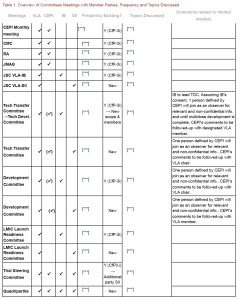
- Provide a forum for discussion of items and issues raised in the various sub-committee meetings described in Table 1, potentially for JMAG deliberations and decisions where within scope.
- have the authority to approve extensions to Work Package timelines within [***] of the originally planned timeframe as set out in the relevant Work Package, provided that each such extension is at no cost to CEPI and does not impact the overall completion date of the Project;
- have the authority to approve transfer of funds between cost categories within a Work Package Project Budget, to the extent that any such changes are cost neutral;
- review and approve proposed changes and updates to the IPDP;
- review and discuss pre-clinical/nonclinical and clinical trial protocols including any substantial changes;
- review and discuss the regulatory strategy for the use of the Product and receive regular updates on regulatory filings and submissions;
- review the contractual and operational status and capabilities of Trusted Collaborator(s) (if applicable);
- review and discuss publications;
- coordinate the sharing of any Project Results identified in the Work Package as intended for use by other CEPI awardees;
- review and update the Equitable Access plans;
- discuss plans, as appropriate, for the development and manufacturing and its scale-up and scale-out;
- approve the progress reports on an agreed upon schedule;
- review any reports and updates provided by any site visit groups;
- provide a forum for coordinating the Parties’ responses to issues with respect to the Project Vaccine, to the extent relating to CEPI’s use in the Field, including unexpected disruptions to the supply of the Project Vaccine, recalls, safety issues or withdrawals of the Project Vaccine;
- receive written notification of all Project Results; and
- make such other decisions as may be delegated to the JMAG pursuant to the Agreement or by written agreement of the Parties.
Limitations on JMAG
The JMAG has no right to do any of the acts set out below. These acts can only be done by CEPI or jointly by the Parties as set out in the Agreement:
- confirm willingness to fund any additional Work Packages (such decision is to be made solely by CEPI);
- approve the Financial Reports;
- approve completion of the Project;
- amend or vary the provisions of the Terms and Conditions,
- approve any Sub-Awardee(s) to the extent not identified in the IPDP
- alter the fundamental scope or objectives or agreed completion date of the Project; and
- approve an overall increase to a Project Budget or timeline.
JMAG Composition
The JMAG Members shall be comprised of the following persons:
- Two “Voting Members”, who will be the Awardee Project Lead (who shall also be the chairperson of the JMAG) and theCEPI Project Lead. The Awardee Project Lead or nominee and the CEPI representative or nominee shall both have the right to vote on matters brought before the JMAG and falling within the JMAG remit. CEPI may, at its sole discretion, appoint or remove the CEPI representative or nominee by notice in writing to the Awardee; and
- “Non-Voting Members” Each of the Parties may invite those persons whose special skills or knowledge might advance theProject, to attend and address the JMAG meetings as observers. Such Non-Voting Members shall not have a right toparticipate in the JMAG decision-making process. The Project Lead shall ensure that any such attendees sign confidentiality agreements in a form acceptable to all Parties. Each Party shall pay for the reasonable documented travel expenses and/or consulting fees of the Non-Voting Members it proposed and shall ensure that such travel is conducted in accordance with CEPI’s Travel Policy.
Quorum
The quorum for JMAG meetings shall be the two (2) Voting Members. Decisions of the JMAG shall be made by unanimity of theVoting Members. Where consensus cannot be reached, the matter shall be escalated in accordance with Clause 23.1 of the Agreement.
5. Project Team and JMAG Meetings, and committee meetings
Each new team, sub-team and JMAG will have a kick-off meeting to start its activities and each team, sub-team and JMAG will have a final close-out meeting to end the operation of the team/sub-team and capture the lessons learned.
The Awardee’s Project Lead or his/her designee, shall be responsible for organising all meetings, including preparing meeting agenda, papers and ensuring that minutes of meetings are produced promptly after each meeting and circulated to Members in a timely manner.
For this CfP-3iii grant, and the nature of proposed arrangement with 3 partners including Valneva, Instituto Butantan and SerumInstitute of India, the organisation and management of all meetings described in the Table 1 will lie with the awardee, i.e. Valneva, unless stated otherwise. Decisions at submeetings will be brought to the JMAG for information, and for decision where applicable, as described in JMAG remit in Section 4 of this document.
The agreed governance structure in Table 1 follows the principles of allowing enough exchange between all Parties for areas where this is needed, while at the same time keeping committees and meetings limited and as small as possible, to allow efficient management of all collaborations considering the number of Parties and time zones involved. General operational guidelines for theParties include that (1) presentations are to be shared at a minimum [*** in advance, (2) meeting minutes are to be drafted within[***] following the meeting, and (3) meeting minutes comments are to be received within [***] after distribution of the draft minutes.
Annex C. Integrated Product Development Plan (IPDP)
4. Management
A. Project Governance
Refer to Team charter for governance arrangements and meeting cadence
Valneva’s project management will lead program management of the entire chikungunya program throughout the duration of the contract. This will include total project lifecycle management, comprising project planning, execution, monitoring, controlling, and closure. Project management will monitor and maintain the Scope of Work (SOW), monitor the program budget and timeline, coordinate project communications internally and with external project stakeholders, prepare reports, and assist in satisfying the CEPI reporting requirements.
Governance bodies with Butantan have been set-up in order to oversee the new Technical Development activities, the Butantan Development plan, the interactions with ANVISA and WHO-PQ as well as the clinical activities in Brazil. The governance bodies encompass:
- A Joint Steering Committee to oversee the development of the BUTANTAN Product based on the BUTANTAN Development Plan
- A Development Committee to (i) approve updates and changes to the BUTANTAN Development Plan; (ii) supervise the activities of the Development Team and the development of the VLA1555 Vaccine Candidate; (iii) resolve issues referred by members of the Development Team; (iv) make strategic decisions related to the BUTANTAN Development Plan; (v) review the progress of the BUTANTAN Development Plan and any related activities; (vi) approve budgets associated with the BUTANTAN Development Plan; (vii) otherwise oversee the BUTANTAN Development Plan, and (vii) monitor the LatAm Studies.
- The former Tech Transfer Committee evolved into the Technical Development committee to oversee the next development activities for VLA1555. This committee and the activities associated are led by Butantan with the support of VLA if needed.
- A Joint Steering Committee, Development Committee and Tech Transfer Committee will also be set up with Serum Institute of India.
Appendix B
The outlined RASCI Chart reflects the Valneva project team environment responsible for execution of the project. Valneva internal approvals will be done by the outlined committees:
The Research & Development Operational Committee (RDOC) oversees and steers VLA’s global research & development programs within agreed strategies and budgets ensuring most appropriate, cross-functionally aligned scientific, medical and technical execution of R&D activities, including the company’s innovation agendas.
The Operations Committee (OpsCo) oversees and steers VLA’s global industrial operations including manufacturing, supply, quality & regulatory compliance, EH&S and facilities (global), ensuring most appropriate manufacturing & site operations and product supply to demand & quality to internal and external customers.
The Management Board (MB) beside its responsibility for overall corporate and financial strategy and its reporting obligations to the Supervisory Board will focus on the legal representation of the company under the relevant jurisdictions. Further key aspects covered by the MB will be organizational structure, top management and governance development, corporate development, business compliance, investor relations and communications. Functional representatives will also be invited as needed for relevant topics.