MAPGuideⓇ
Equitable Access Toolkit
Approaches to IP Rights Management Provisions in License Agreements
The scope of rights and obligations included in collaboration, license and technology transfer agreements generally includes use of the existing intellectual property rights (“background IP”) of one or more parties to the agreement. New intellectual property rights (“foreground IP”) may also be generated during the performance of activities under the agreement. Agreement provisions related to the management of these IP rights can play an important role in facilitating access to licensed products and technologies. In particular, these provisions should address:
Who owns and has rights to use any foreground IP arising under the agreement
If and how IP will be protected through patent filing and enforcement activities
If and when sublicensing is permitted or required to support equitable access
As outlined in the diagram below, there are different potential approaches to each of these elements.
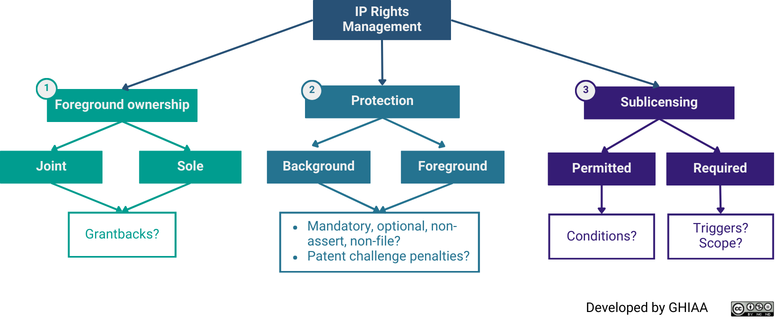
1. Foreground IP ownership
License agreements commonly provide for licensees to retain ownership of the foreground IP (sometimes referred to as “inventions” or “improvements“) that they generate under the agreement. Agreements involving R&D collaboration will also need to consider treatment of any IP developed jointly between the collaborating parties. This may need to take into account how joint IP is governed across the different jurisdictions in which the collaboration partners are operating.
A related consideration for these provisions is whether the licensor should have the right to use foreground IP owned by the licensee (or if collaboration partners should have the right to use each other’s foreground); such rights are sometimes referred to as “grantbacks”. In some cases, grantback obligations may include license grants to entities that are not directly party to an agreement, such as a head licensor, or an R&D funder.
The scope of any grantbacks may be broad, allowing use by the licensor for worldwide development and commercialization purposes in any field, or it may be restricted to certain uses such as achieving access objectives or for the fulfilment of agreement obligations. Additional considerations for grantbacks include: (i) whether any royalties will be due for exercise of the rights; (ii) any restrictions on sublicensing; and (iii) whether the grantback will be on an exclusive or non-exclusive basis.
Examples from the MAPGuide
All Joint Program Technology and Joint Program Patent Rights shall be jointly owned by the Parties and each Party shall be free to practice such Joint Program Technology and Joint Program Patent Rights in its Territory, subject to any terms or conditions of this Agreement to the contrary.
Related definitions:
- “Joint Program Patent Rights” means any Patent Rights that contain one or more claims to the Joint Program Technology or Joint Program Materials.
- “Joint Program Technology” means any (a) Technology that is conceived or first reduced to practice (actually or constructively), whether or not patentable, jointly by or on behalf of [Collaborator 1] or its Affiliates’ personnel, on the one hand, and [Collaborator 2] or its Affiliates’ personnel, on the other hand (including any subcontractors or consultants to [Collaborator 1] or [Collaborator 2]) in the conduct of or otherwise in connection with the performance of Development Activities pursuant to the Development Plan.
Source: taken from a co-development, supply and commercialization agreement between Ocugen and Bharat Biotech. Partner types: industry; Product type: COVID-19 vaccine (covaxin); Development stage at signature: emergency use approval in India. Read in context.
If Project IP is conceived or reduced to practice (in the case of patentable Project IP), authored (in the case of Project IP subject to copyright) or contributed to (in the case of all other forms of Project IP) during activities carried out under the Research Plan solely by or on behalf of a single Party, then such Party solely owns such Project IP. If Project IP is conceived or reduced to practice, authored or contributed to, as the case may be during activities carried out jointly by or on behalf of two (2) or more Parties under the Research Plan, then such Parties jointly and equally own such Project IP (“Joint Project IP”), unless otherwise agreed between them. Inventorship of Project IP is determined in accordance with applicable national law where the invention is made.
Source: taken from an anonymised agreement for a collaboration between an academic institution and a company, supported by a funder. Read in context.
Licensee hereby grants to [Licensor] a nonexclusive, royalty–free, worldwide, sublicensable license to all improvements, methods (including manufacturing processes), modifications and other know–how, including any chemistry improvements or modifications, developed by or on behalf of Licensee and relating to API or a Product (“Improvements”), subject to the restrictions on further transfer of Licensee’s technology by [Licensor] as set forth in Section [x]. Licensee shall, as between [Licensor] and Licensee, own all such Improvements and shall, as between Licensee and [Licensor], have the sole right, but not the obligation, to pursue intellectual property protection with respect to such Improvements.
Source: taken from a Gilead template license agreement for generic manufacturing. Partner types: industry; Product type: HCV therapeutic (sofosbuvir, ledipasvir); Development stage at signature: licensed product. Read in context.
[Transfer Recipient] grants to [Transferor] a non-exclusive, non-transferable but sublicensable, irrevocable, fully paidup, royalty-free, licence to practice and have practiced the data and the Inventions for the purposes of fulfilling its mission to facilitate the development and equitable access of health technologies in the Territory. In the event that [Transferor] wishes to make such Inventions available for other purposes, [Transferor] and [Transfer Recipient] will enter into good-faith negotiations. [Transfer Recipient] agrees to provide to [Transferor] a licence in relation to any of its background rights only to the extent necessary to enable the use and exercise of the Inventions made by [Transfer Recipient] hereunder.
Related definitions: “Inventions” shall mean all ideas, inventions, discoveries, data or Know-How conceived, first created or made in the performance of the Project.
Source: taken from a technology transfer agreement between MPP (Transferor) and Biovac (Transfer Recipient) under the WHO mRNA Technology Transfer Programme. Partner types: multilateral, industry; Product type: COVID-19 vaccine; Development stage at signature: early stage development. Read in context.
Commercialisation Partner will grant to [Licensee] and [Licensor] a perpetual, irrevocable, worldwide, royalty-free, non-exclusive, sub-licensable licence over any Improvement (and shall promptly execute such document as [Licensor] may reasonably request accordingly). Such licence will not affect the Commercialisation Partner’s ownership of the Improvements. Commercialisation Partner will agree to engage in good-faith negotiations should [Licensee] desire to further sublicense such Improvements. [Licensor] shall be entitled to grant sub-licences (without further right to sublicense) to other third parties, provided that it will be prohibited from sublicensing to a Direct Competitor (to be defined in the Commercialisation Agreement) of the Commercialisation Partner in the Territory without its written consent.
Source: taken from a commercialization agreement term sheet annexed to license agreement between the University of Liverpool (Licensor) and MPP (Licensee). Partner types: multilateral, academic institution; Product type: HIV therapeutic (nanomedicine); Development stage at signature: early clinical. Read in context.
[Licensee] acknowledges that the [Licensor] has agreed to the following grantback (the “Humanitarian License”) pursuant to the [Funder] Agreements for the CV Field of Use, and the University will retain rights under the Licensed Patents and License Know-How necessary to comply with the Humanitarian License below (where You is the [Licensor]), subject to the terms and conditions contained in Exhibit D: Subject to applicable laws and for the purpose of achieving Global Access, You grant the [Funder] a nonexclusive, perpetual, irrevocable, worldwide, royalty-free, fully paid up, sublicensable license to make, use, sell, offer to sell, import, distribute, copy, create derivative works, publicly perform, and display Funded Developments and Essential Background Technology. “Essential Background Technology” means Background Technology that is: (a) owned, controlled, or developed by You, or in-licensed with the right to sublicense; and (b) either incorporated into a Funded Development or reasonably required to exercise the license to a Funded Development. If You demonstrate to the satisfaction of the [Funder] that Global Access can best be achieved without this license, the [Funder] and You will make good faith efforts to modify or terminate this license, as appropriate.
Source: taken from a license and exclusive option agreement between the University of Washington (Licensor) and Icosavax (Licensee). The licensed IP was funded partially by the Gates Foundation. Partner types: academic institution, industry; Product type: COVID-19 vaccine; Development stage at signature: preclinical.
2. IP protection
IP protection provisions in license and collaboration agreements generally address rights and obligations related to the prosecution, maintenance and enforcement of patent rights for the licensed IP.
Equitable access considerations may be incorporated into these provisions through commitments not to file and/or not to enforce patents in certain countries (sometimes referred to as “non-suit” or “non-assert”), or an agreement to for the parties to consider the potential impact on equitable access prior to making IP protection decisions for certain countries. These requirements may be aligned with a licensors IP or socially responsible licensing policy.
It should however be noted that patent filing can, in some cases, be in the interest of facilitating equitable access as a guard against the possibility of patent filings by other parties which may limit opportunities for pursuing equitable access objectives. Patents can also be a mechanism for attracting further funding and future partners for further development and commercialization of a licensed product in lower-income markets.
Other general considerations for provisions related to IP protection, as discussed further here, include: (i) whether the licensor is permitted to abandon patents; (ii) obligations for the agreement parties to cooperate on patent filing and enforcement activities; and (iii) which party is responsible for IP protection expenses.
Examples from the MAPGuide
[…] [Licensor] expressly reserves the right to decline Licensee’s request to file, prosecute, maintain or defend any of the Patent Rights in any Developing Country(ies) unless Licensee demonstrates to [Licensor]’s reasonable satisfaction that the filing, prosecution, maintenance or defense of such Patent Rights in such Developing Country(ies) would materially increase the locally-affordable availability of Licensed Products or equivalents thereof (e.g., generic products) in those and/or other Developing Country(ies). […] Licensee agrees that [Licensor] shall hold final decision-making authority, on a case-by-case basis, as to whether Licensee will be permitted to enforce such Patent Rights in such Developing Country(ies).
Source: taken from a license agreement between Harvard University and Tectonic Therapeutic. Partner types: academic institution, industry (university spin out company); Product type: therapeutic (details redacted in publicly available agreement); Development stage at signature: early stage development. Read in context.
So long as COMPANY remains the exclusive licensee of the PATENT RIGHTS in the FIELD in the TERRITORY, COMPANY, to the extent permitted by law, shall have the right, under its own control and at its own expense, to prosecute any third party infringement of the PATENT RIGHTS in the FIELD in the TERRITORY, […] Prior to commencing any such action, COMPANY shall consult with [Licensor] and shall consider the views of [Licensor] regarding the advisability of the proposed action and its effect on the public interest, including without limitation the availability and accessibility of LICENSED PRODUCTS at a reasonable price to people most in need within DEVELOPING COUNTRIES.
Source: taken from an exclusive license agreement between M.I.T. (Licensor) and Visterra (Licensee). Partner types: academic institution, industry; Product type: dengue monoclonal antibodies; Development stage at signature: pre-clinical. Read in context.
After the Effective Date, Licensee shall be responsible for all future costs of filing, prosecution and maintenance of all foreign patent applications, and patents contained in the Licensed Patents in the countries outside the United States in the Licensed Territory selected by [Licensor] and agreed to by Licensee or requested by Licensee. All such applications or patents shall remain the property of [Licensor]. […] Licensee acknowledges that [Licensor] shall not file any such applications in low or lower-middle income countries, as designated by the World Bank (www.worldbank.org).
Source: taken from a license agreement between Yale University (Licensor) and BIND Biosciences (Licensee) for the development and commercialization of licensed products and methods for the treatment of cancer. Partner types: academic institution, industry; Product type: cancer treatment; Development stage at signature: unknown. Read in context.
[Licensor] and Licensee on behalf of themselves and any successors-in-interest to the Licensed Products and Licensed Processes covenant that they will not, before or after the Effective Date of this Agreement, assert any claim of patent infringement (including direct infringement, contributory infringement, and induced infringement) under any of the patents in the Patent List, any Licensed Processes or any Orange Book Patent Right for manufacture, use, sale, offer for sale or importation of Licensed Products against any third party engaged in the manufacture, use, sale offer for sale, or importation of Licensed Products in or for Non-Suit Countries for sale to Public Sector entities. The above notwithstanding, this non-suit provision will only apply to products which when offered for sale to End Users are in a Trade Dress that is different from Licensee’s Trade Dress in every respect.
Related definitions:
“Non-Suit Countries” means all countries other than Market Countries.
“Market Countries” means:
(a) All current and future Organization for Economic Cooperation and Development (OECD) countries, presently consisting of Australia, Austria, Belgium, Canada, Czech Republic, Denmark, Finland, France, Germany, Greece, Hungary, Iceland, Ireland, Italy, Republic of Korea, Japan, Luxembourg, Mexico, the Netherlands, New Zealand, Norway, Poland, Portugal, Spain, Sweden, Switzerland, Turkey, the UK, and the United States; and
(b) All current and future members of the European Union not otherwise members of the OECD; and
(c) People’s Republic of China, India, Malaysia, Russian Federation, Singapore, South Korea and Taiwan].
Source: taken from Boston University’s template license agreement. Partner types: industry; Product type: multiple; Development stage at signature: multiple. Read in context.
3. Sublicensing & technology transfer
The scope of a license grant may permit sublicensing to third parties (potentially subject to certain conditions as discussed here). However, some license and collaboration agreements may include specific obligations for sublicensing and technology transfer in certain circumstances including:
- As a continuity mechanism in the interests of achieving affordability or availability objectives for the licensed product or technology;
- If the licensee has chosen not to commercialize a licensed product in certain markets; and/or
- Pursuant to an access plan agreed between the licensee and licensor.
Sublicensing and technology transfer requirements may be subject to certain restrictions including: (i) a first right for the licensee to demonstrate its intention and capacity to meet the needs of underserved markets; (ii) identification of a suitably qualified sublicensee able to meet required quality standards; (iii) negotiation of a sublicense agreement on reasonable terms that will not interfere with the licensee’s business strategy; and/or (iv) identification of a sublicensee that is not a direct competitor of the licensee.
Examples from the MAPGuide
Partner shall transfer manufacturing technology in full to one or more Third Party manufacturers if such transfer reduces the cost of the Product in accordance with a technology transfer plan mutually agreed upon by the Parties which shall include, at a minimum the terms attached hereto as Annex [x], provided that (i) such Third Party manufacturers’ quality standards meets Good Manufacturing Practice; and (ii) the transfer will not delay access to the Product in the Territory.
Source: taken from DNDi’s template Development Collaboration and License Agreement. Partner types: PDP, industry/academic institutions; Product type: treatments for neglected diseases; Development stage at signature: template intended for use from Phase 1 clinical trials through to proof of concept in humans. Read in context.
Licensee, together with its Subsidiaries and/or Sublicensees, shall have the first right to develop, manufacture, have manufactured, import, have imported, offer for sale, sell, have sold or otherwise distribute or have distributed such Licensed Product or equivalent thereof (e.g., a generic product) to make such Licensed Products generally available at locally-affordable prices in any Developing Country(ies) which are chosen by Licensee and/or its Subsidiaries and Sublicensees in their sole discretion. […]
Step-in Rights for Licensed Products in Developing Countries. At any time after [***] following [***], if Licensee, together with its Subsidiaries and/or Sublicensees, has not chosen to exercise its first rights to make such Licensed Products generally available at locally-affordable prices in accordance with Section [x] above in any particular Developing Country, [Licensor] may notify Licensee in writing of a not-for-profit Third Party to whom [Licensor] would like Licensee to grant a Sublicense under the Patent Rights to develop, manufacture, have manufactured, import, have imported, offer for sale, sell, have sold or otherwise distribute or have distributed such Licensed Product or an equivalent thereof (e.g., a generic product) for use in the Field, solely for sale or other distribution of such Licensed Product or equivalent on a locally-affordable basis in any Developing Countries in which such Licensed Product is not then available on a locally-affordable basis (a “Developing Country Sublicense“). […]
Source: taken from a license agreement between Harvard University (Licensor) and Tectonic Therapeutic (Licensee). Partner types: academic institution, industry; Product type: unknown; Development stage at signature: unknown. Read in context.
If [Licensor] or [Licensee] or an AFFILIATE receives a bona fide request from a capable third party for a license under the Patent Rights to develop and commercialize a Licensed Product and/or Licensed Process at affordable prices in one or more Developing Countries that is not being sold (including without limitation sufficient supply to meet market demand at reasonable costs) or diligently developed for sale by [Licensee] or an Affiliate or Sublicensee in such Developing Country(ies), then the party receiving such inquiry shall promptly notify the other party in writing within [**] days of such inquiry (an “Inquiry Notice“), setting forth the type of Licensed Product and/or Licensed Process desired, the commercialization area desired, the name and contact information of the third party, and any other pertinent information.
Within [***] months of such Inquiry Notice, during which time [Licensee] may consult with [Licensor] regarding the request, [Licensee] shall enter into a sublicense agreement containing commercially reasonable terms and conditions with such third party for the requested Licensed Product and/or Licensed Process in the requested Developing Country(ies). If [Licensee] does not grant a sublicense under the Patent Rights to the third party within [***] months of such Inquiry Notice, and [Licensor], at its sole discretion, determines that a sublicense to the third party is reasonable under the totality of the circumstances (taking into account development efforts of [Licensee], Affiliates and Sublicensees) to make Licensed Products and/or Licensed Processes available in Developing Countryies, then [Licensor] shall have the right to grant a non-exclusive license under the Patent Rights to such third party for such purposes and shall notify [Licensee] of any such license that is granted. For clarity, any license granted by [Licensor] under this Section [x] shall be solely for bringing Licensed Products and/or Licensed Processes to market in the requested Developing Country(ies) (and other countries mutually agreed to by [Licensor] and [Licensee]) in a manner that enables availability and accessibility at reasonable cost, and shall specifically exclude the right of the third party licensee to export or sell Licensed Products and/or Licensed Processes from such Developing Country(ies) (and other countries mutually agreed to by [Licensor] and [Licensee]) into other markets. Notwithstanding the foregoing, any such license granted by [Licensor] under this Section [x] shall allow the third party licensee to export or sell Licensed Products and/or Licensed Processes from a Developing Country(ies) into any other Developing Country(ies) during any period of time in which an adequate supply of such Licensed Products and/or Licensed Processes at accessible pricing is not available in such other Developing Country(ies).
Source: taken from an exclusive license agreement between M.I.T. (Licensor) and Visterra (Licensee). Partner types: academic, industry; Product type: dengue monoclonal antibodies; Development stage at signature: pre-clinical. Read in context.
Within six (6) months of NDA/BLA equivalent approval in any Licensed Territory, Licensee shall send a written report to [Licensor] detailing the potential Public Sector market to fulfill the public health need for the approved Licensed Product in Developing Countries, including the impact of any approved competing Licensed Product. The report shall also include Licensee’s amendment to the Commercial Development Plan, Appendix F, to satisfy said potential Public Sector market either directly with Licensee’s own resources and/or through joint ventures with third parties. Acceptance of this report and amendment is required by [Licensor] in writing, such acceptance will not be unreasonably denied.
[…]
To the extent that Licensee shall satisfy the potential Public Sector market through joint ventures with third parties, Licensee shall:
(i) Within one (1) year after First Commercial Sale, make commercially reasonable efforts to negotiate with third parties in order to effect joint ventures or other partnership agreements to make and sell the Licensed Products and Licensed Processes and (or to assist in development of similar third party licensed products or processes made under license directly between the third party and [Licensor] for the technology covered by the Agreement [hereinafter “Third Party Products”]) to provide know-how and effect technology transfer to said third parties that will allow them to manufacture a safe and effective Licensed Product (or Third Party Products) for distribution and/or sale in Developing Countries.
(ii) Within two (2) years of First Commercial Sale, and provided there is a commercially reasonable market therefore, make commercially reasonable efforts to have entered into at least one (1) joint venture or other partnership agreement with at least one (1) third party for the purpose of manufacturing a safe and effective Licensed Product or Third Party Product for distribution and/or sale in Developing Countries.
(iii) Subject to (ii) above, Within four (4) years of First Commercial Sale, ensure that any said third party(ies) have made commercially reasonable efforts to have delivered a first allotment of a safe and effective Licensed Product or Third Party Product to the Public Sector for distribution and/or sale in Developing Countries , and thereafter ensure that said third party(ies) use commercially reasonable efforts to meet any delivery date(s) and in the quantities required in an order placed by the Public Sector.
Source: taken from a license agreement between the U.S. NIH (Licensor) and Aridis (Licensee). Partner types: public research institute, industry; Product type: rotavirus vaccine; Development stage at signature: early stage development. Read in context.
If a Third Party notifies [Licensor] after the Option Effective Date that it wishes to license any of the exclusively Licensed Rights in any territory in which [Licensee] is unable or unwilling to develop and market a Licensed Product that [Licensor] reasonably believes [Licensee] is not diligently pursuing, [Licensor] will notify [Licensee] in writing of such Third Party’s wish to obtain such license, and [Licensee] will have good faith discussions with such Third Party regarding the terms and conditions under which such Sublicense could be obtained. [Licensee] will not be obligated to provide such sublicense where it interferes with [Licensee]’s business strategy; however, [Licensee] will not unreasonably withhold such Sublicense.
Source: taken from a license and exclusive option agreement between the University of Washington (Licensor) and Icosavax (Licensee). The licensed IP was funded partially by the Gates Foundation. Partner types: academic institution, industry; Product type: COVID-19 vaccine; Development stage at signature: preclinical.
Do plans for potential sublicensing and technology transfer align with the capacity of third party manufacturers? Is third party funding available to support technology transfer activities?
Will IP protection and sublicensing strategies be developed as part of an equitable access plan?
How should publication or results or other data sharing requirements align with IP protection considerations?
Will the licensee be required to pass through access obligations to future sublicensees or development and commercialization partners?
Should the parties be required to notify each other of the creation of foreground IP or activities related to IP protection?
Will a joint steering committee have oversight of the IP protection and or sublicensing strategy?
This toolkit has been built based on the data in the MAPGuide and the GHIAA team’s experience of negotiating and implementing agreements. We intend that the toolkit will evolve and expand over time based on input from MAPGuide users and availability of new agreements showing examples of alternative approaches. We welcome ongoing constructive dialogue around these materials and encourage you to contact us or fill in our feedback survey to share your thoughts, questions and suggestions.