MAPGuideⓇ
Equitable Access Toolkit
Supporting Affordable Pricing through License Agreement Provisions
License agreements can use a number of different mechanisms to support the affordability of an end product. The diagram and explanations below provide an overview of these mechanisms and some of the key factors that may impact their suitability depending on the context of a specific license agreement. However, this commentary is not intended to provide a comprehensive assessment of the complexities of product pricing or licensing fee structures, nor the potential impact of national laws and regulations on these topics.
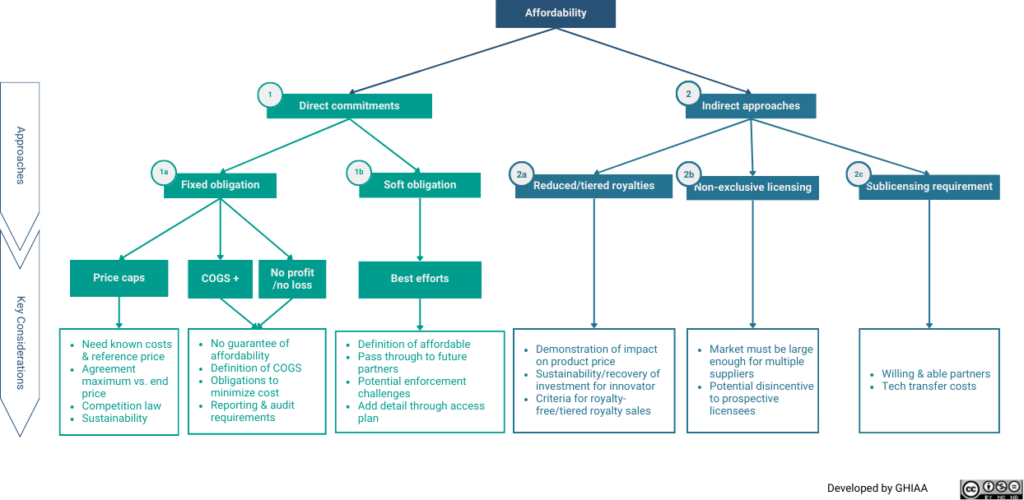
1. Direct commitments
a. "Fixed" pricing obligations
Fixed pricing obligations are those that set a specific price threshold, for example a maximum absolute price cap, a maximum percentage mark-up over the cost of goods (“COGS”) (also referred to as “cost plus” or “COGS+”), an obligation to sell a product at no profit, or a combination of a COGS-based formula with a “not to exceed” price. It is important that any fixed pricing commitments are informed by an understanding of likely procurement pathways and the affordability requirements of the likely purchasers of the end product. The development of access roadmaps with relevant stakeholders may be a useful approach for addressing these questions.
Additional considerations for fixed pricing commitments include:
Stage of development
Fixed pricing provisions are more likely to be suitable for license agreements under which the licensee is expected to manufacture and supply a licensed product itself, and therefore has direct knowledge of expected manufacturing costs. Cost-based pricing commitments could potentially be used in agreements for products in earlier stages of development, but absolute price caps may be most suitable for license agreements related to generic or biosimilar medicines for which reference prices are available.
COGS definition
COGS-based pricing requirements need to be supported by a definition stating the types of cost to be included in the calculation of COGS that will form the basis of the agreed product price. COGS definitions are sometimes tied to accounting principles (for example, “as calculated under U.S. GAAP”), but other agreements separately list the cost categories that may be included in the COGS calculations as accounting standards may not address all of the considerations relevant to the specific goals of affordability and appropriate returns to support sustainability. Further details are set out in the Gates Foundation’s Production Economics for Vaccines handbook.
Other impacts on affordability
The success of cost-based pricing frameworks is dependent on the COGS achieved and does not guarantee that the price of the product will be affordable for the intended purchasers. Further, a maximum price or margin to be charged to a procurement agency may not reflect the final price/margin paid by patients or end users of a product. For example, freight and distribution costs, as well as ongoing service and maintenance requirements for diagnostics and devices, can add significant extra costs for end users.
Sustainability
Maximum prices or margins need to be sustainable. The caps set in funding agreement provisions therefore need to align with both the prices that purchasers are willing and able to pay, and the minimum margin needed for the licensee to be willing and able to continue supplying the product.
Obligations to minimize costs
There is a risk that a licensee will default to the maximum price or margin defined in the agreement, even if it is actually able to sustain a lower price. Further, fixed pricing obligations may not incentivize licensees to seek cost efficiencies over time. A potential approach to mitigating these challenges is through requirements for the licensee to make efforts to minimize COGs and pass through savings as economies of scale are achieved.
Legal compliance
Agreements that require specified prices will need expert legal review to consider potential conflicts with applicable competition laws.
Reporting & audit rights
Licensors can monitor licensee compliance with pricing obligations through requirements to provide periodic reports on sales values and volumes. Audit rights can also enable licensors to review compliance with underlying COGS and pricing calculations.
b. "Soft" pricing obligations
A soft pricing obligation is one that requires a licensee to make best or reasonable efforts to achieve an affordable price for the final product, but without setting any specific parameters on what this price should be. Soft pricing obligations often recognize the need for a price that is both affordable for the populations in need of a product and commercially sustainable for the developer in order to promote long-term and widespread access to the product. Soft pricing obligations may also require licensees to apply tiered pricing frameworks, or supply a licensed product to certain purchasers at a preferential price.
The nature of soft pricing obligations means that they are more straightforward for an early-stage licensee to pass through in downstream license agreements. However, without a quantified expected price or clear standard for determining what is “affordable”, these obligations are subjective, which means they could be difficult to enforce in the event of a dispute. One approach that could help to mitigate this challenge is to include a high level affordable pricing provision in early stage licensing agreements along with a requirement to develop more detailed pricing commitments when certain stages of product development are reached. These more detailed commitments can be documented in an evolving access plan that is annexed to the license agreement.
Examples from the MAPGuide
"Fixed" pricing obligations
[Commercial partner] will, other than the clinical trial supplies as discussed in section [x], supply [Product] to [non-profit partner] at the following prices: Fully-Burdened Manufacturing Cost increased by a margin not exceeding [***] for all supplies of [Product] for use in the Field and Distribution Through the Public Sector in the Territory. Once [commercial partner] receives a first approval for [Product], [commercial partner] shall supply [Product] to [non-profit partner] at [commercial partner]’s Fully-Burdened Manufacturing Costs increased by a margin not exceeding [***] for all supplies of [Product] for use in the Field and Distribution Through the Public Sector in the Territory. [Commercial partner] and [non-profit partner] agree that the cost for lot failures, batch failures, or other quality control or productions failures (collectively “failures”) will be shared equally between the parties and [commercial partner] shall keep all the necessary records to document failures and allocate costs accordingly.
Related definitions: “Fully-Burdened Manufacturing Costs” means: the costs of all raw materials and labor used or consumed in such manufacture, packaging costs and expenses, shipping, handling, and delivery costs related to delivery of [Product], quality assurances and quality control related expenses and all overhead amounts allocable to such manufacturing and delivery (including without limitation amortized capital equipment costs) provided that: (1) all of the foregoing shall be calculated in accordance with US GAAP, (ii) [commercial partner] shall, notwithstanding anything to the contrary in the Agreement, use commercially reasonable efforts to minimize Fully–Burdened Manufacturing Costs.
Source: taken from a research collaboration agreement between DNDi (non-profit partner) and BioDelivery Sciences International (commercial partner). Partner types: industry, PDP; Product type: treatment of African Human Trypanosomiasis , Chagas disease, and Visceral & Cutaneous Leishmaniasis (CAMB, a formulation of Amphotericin B); Development stage at signature: pre-clinical. Read in context.
In furtherance of the access objective of making Licensed Product for the Territory available at an affordable and sustainable price, the Sublicensee shall sell Licensed Product to Customers at a price equal to the cost of goods to Manufacture Licensed Product plus a maximum agreed profit margin, calculated in accordance with the principles set out in Schedule I hereto. The actual price at which the Sublicensee shall sell Licensed Product to any given Customer shall be negotiated by the Sublicensee in each Supply Agreement, but shall in any case be subject to the maximum price calculated in accordance with the principles set out above.
The Sublicensee shall make all its accounts used to calculate its cost of goods available to [sublicensor] or its agent on an open book basis and shall report these costs to [sublicensor] on a regular basis in accordance with Section [x] and make its accounts available for audit in accordance with Section [x].
SCHEDULE I. Licensed Product Maximum Price
a. Principles applicable to the calculation of cost of goods to Manufacture Licensed Product. For the purposes of the Sublicense Agreement, the Sublicensee’s cost of goods to Manufacture Licensed Product shall consist of the following elements:
- Raw Material Costs
- Packaging Material Costs (glass vial, insert, pallet….)
- Direct Labor Costs
- Quality Control Costs
- Attributable Administrative Overhead Costs
- Investment costs (Depreciation cost for dedicated FDF facility), but only during the agreed depreciation period
- Loan interest for FDF facility investment, but only until the end of the agreed depreciation period
- Following the finalization of the Manufacturing process for Licensed Product and Licensed Compound, the Sublicensee shall present to GARDP a calculation of the cost of goods for the Manufacture of Licensed Product based on the above principles, and GARDP shall conduct an audit of the Sublicensee’s accounts relating to such costs. Based on such presentation and audit, the Parties shall discuss the initial cost of goods to be used for the calculation of the price of Licensed Product.
b. Maximum profit margin
Initial maximum profit margin: [Twenty five Percent (25%)]
The Sublicensee shall regularly consider implementing actions that would enable it to reduce its cost of goods for Licensed Product without negatively impacting quality. The benefit of any such reduction in costs achieved by the Sublicensee shall be shared equitably between a reduction in the price charged by the Sublicensee to its customers and an increase in the Sublicensee’s margin.
Source: taken from a sublicense agreement between GARDP (Sublicensor) and Orchid Pharma (Sublicensee) related to a head license between GARDP and Shionogi. Partner types: PDP, industry; Product type: antibiotic (cefiderocol); Development stage at signature: licensed product on WHO EML. Read in context.
In the event that [transfer recipient] develops and commercialises a Product that is responsive to a Public Health Emergency of International Concern as declared by WHO, to as soon as practically possible make available no less than ten percent of its real-time production capacity of Product for WHO and/or Public Sector Agencies at a price to be negotiated in good faith, but in no event to exceed its Cost of Production plus a twenty percent mark-up
Source: taken from a technology transfer agreement between MPP (transferor) and Biovac (transfer recipient) under the WHO mRNA Technology Transfer Programme. Partner types: multilateral, industry; Product type: COVID-19 vaccine; Development stage at signature: early stage development. Read in context.
Licensee agrees that Licensed Products will be offered for sale in low and lower-middle income countries at a price that is equal to Licensee’s actual cost to manufacture and distribute such Licensed Products
Source: taken from a list of example clauses from executed U.S. university license agreements published in the AUTM global health toolkit.
If a Payor, or its Related Parties develop a Licensed Product for a Target that covers a disease that afflicts a significant portion of the population in the Developing World (being those countries of the world defined from time to time as low income or lower middle income by the World Bank – see: http://www.worldbank.org/data/countryclass/classgroups.htm), then such Payor and its Related Parties will use commercially reasonable efforts to commercialize such Licensed Product in a manner consistent with the UBC Global Access Principles. For the purposes of this Agreement, Global Access Principles means the provision of the UBC Controlled IP and any such Licensed Products at cost to the people in the Developing World; provided, however, that nothing contained herein shall require such Payor or its Related Parties to build infrastructure or distribution networks in the Developing World.
Source: taken from a sponsored research agreement between the University of British Columbia (academic licensor), Alnylam Pharmaceuticals (commercial development partner), and AlCana Technologies (commercial licensor). Partner types: academic institution, industry; Product type: formulations for lipid-based, synthetic RNA/DNA delivery; Development stage at signature: early stage. Read in context.
"Soft" pricing obligations
It is the desire of both [Licensor] and Licensee to make Licensed Products available in the developing world, and it is the parties’ common desire for Licensee to develop Licensed Products that are clinically and economically suited for use in those areas. To that end, the parties shall use commercially reasonable efforts, when possible under good business practice, to facilitate the availability of Licensed Products in low and lower middle–income countries at locally affordable prices, under reasonable circumstances and terms to improve access to such Licensed Products in such countries, provided that failure to do so after due consideration in good faith shall not be treated as a breach of this Agreement by Licensee.
Source: taken from a license agreement between Yale University (Licensor) and BIND Biosciences (Licensee) for the development and commercialization of licensed products and methods for the treatment of cancer. Partner types: academic institution, industry; Product type: cancer treatment; Development stage at signature: unknown. Read in context.
Each Party will use commercially reasonable endeavours to ensure that the Drug Product is made available at price which is affordable and sustainable in its respective Territory and any part thereof;
Source: taken from a collaboration agreement between Entasis Therapeutics and GARDP. Partner types: PDP, industry; Product type: gonorrhea treatment (zoliflodacin); Development stage at signature: Phase III clinical trials. Read in context
[Sublicensor] will require that such Sublicensee(s) use commercially reasonable efforts to ensure that the Product(s) be made available at Affordable Pricing as quickly as possible in sufficient quantities to meet the needs of [disease] patients throughout the world. “Affordable Pricing” as used herein shall mean the lowest sustainable, competitive price for the Product(s) which covers the cost of raw materials, manufacturing, distribution and operational overheads, and includes a reasonable margin to help ensure the economic sustainability of the production and distribution of the Product(s).
Source: taken from a license agreement between Pfizer (Licensor) and MPP (Licensee) for sutezolid. Partner types: industry, multilateral; Product type: TB therapeutic (sutezolid); Development stage at signature: clinical. Read in context.
Partner shall undertake Reasonable Efforts to optimize the manufacture of the Product, so as to make possible a final price ensuring the widespread use of the Product consistent with the Access and Implementation Plan. Partner commits to pass on any significant reduction in the production costs of such materials to the benefit of the sale price. Partner shall be responsible for the distribution, either directly or through any Third Party it may appoint, of the Product in accordance with this Agreement. Following receipt of the applicable Marketing Authorisation, Partner shall make the Product available in the Territory on an Affordable Basis. […]
Disclosure of price composition if access plan not met: In the event that the Product is not achieving the Access and Implementation Plan, which may be attributable to the price of the Product, then DNDi may request and Partner shall disclose to DNDi the composition of the price of the Product, including any allowed Third Party or Affiliate margin and cost mark–up, so that the Parties can resolve the elements of pricing in good faith.
Related definitions: “Affordable Basis” shall mean pricing a Product at the lowest sustainable level which may include only: a) full production costs, as optimised without compromising the quality of the Product; and b) direct distribution costs, and c) a reasonable margin, not to exceed < to be completed > percent of the foregoing costs, for the selling Party.
Source: taken from DNDi’s template Development Collaboration and License Agreement. Partner types: PDP, industry/academic institutions; Product type: treatments for neglected diseases; Development stage at signature: template intended for use from Phase 1 clinical trials through to proof of concept in humans. Read in context.
[Licensee] shall procure that any and all Development and/or Commercialisation Partner commits to achieve the Access Objective including the following specific commitments (the “[Licensee] Licensee Commitments”):[…]
- undertake commercially reasonable efforts to Manufacture the Final Product at the lowest possible cost and pass on any significant reduction in the production and distribution costs of the Final Product to the benefit of the sale price offered to the Public Sector in the Territory;
- agree that compliance with the Price Commitment will be subject to audit by an independent firm of accountants at any time. The result of the audit will be binding, and such Commercialisation Partner should agree to implement any adjustment to the Affordable Price which is deemed required as a result of the audit; […]
For the purposes of this Agreement and any Development and Commercialisation Agreement, the “Specific Access Commitments” are:
- “Price Commitment” – the Final Product will be made available to the Public Sector in the Territory at a price which is no more than the Affordable Price; […]
Source: taken from a license agreement between MedinCell (Licensor) and MPP (Licensee). The license grant to MPP was required under a related grant agreement between Unitaid and MedinCell, with terms to reflect Unitaid’s access objectives. Partner types: industry, multilateral; Product type: malaria vector control (long-acting ivermectin injectable); Development stage at signature: pre-clinical. Read in context.
The price at which each Licensed Product is sold to the Public Sector shall be i) preferential to the lowest Private Sector price, and ii) set at the lowest possible level permitting a commercially reasonable return on worldwide sales of each said Licensed Product.
Source: taken from a license agreement between the U.S. NIH and Biosyn. Partner types: Government, Industry; Product type: HIV prophylactic; Development stage at signature: unknown. Read in context.
2. Indirect approaches
In addition to fixed and/or soft pricing obligations, license agreements can include a number of other provisions that may indirectly support the achievement of an affordable price. These provisions include:
a. Reduced or tiered licensing fees
License agreements typically require the payment of royalties and/or other fees from the licensee to the licensor (for further details see GHIAA’s issue summary on payment structures). These fees form part of the licensee’s total cost of developing and commercializing a licensed product and may be passed on to purchasers as part of the sales price for the product.
To facilitate access to a licensed product, licensors can consider license fee structures that support sustainable, affordable pricing by the licensee while still allowing a fair return to the licensor. A common approach to access-oriented fee structures is to apply reduced or tiered royalty rates for sales in certain markets. These structures may be used in license agreements in conjunction with other access provisions to ensure the intended impact on affordability.
b. Non-exclusive licensing
In addition to the provisions included in the license agreement, licensors can promote price competition, and therefore affordability, by using non-exclusive licensing models that allow multiple generics manufacturers to develop and commercialize a licensed product for the same markets.
c. Sublicensing requirements
License agreements can also support affordability by providing for sublicensing and technology transfer by the licensee under certain circumstances. Sublicensing requirements may form part of enforcement and continuity provisions (for example, if a licensee is unwilling to meet its affordability commitments), but they may also be separate obligations under the agreement which are triggered in the event that a lower cost manufacturer is identified.
Examples from the MAPGuide
Reduced or tiered licensing fees
The Parties will cooperate such that essential medicines which may be developed under this License can be made available in economically disadvantaged nations. [Licensor] agrees to consider reasonable requests of Licensee for a commensurate reduction of royalty and sublicensing fees in circumstances where Licensee demonstrates to the satisfaction of [Licensor] […] that Licensed Products are or will be made available in such nations at reduced cost.
Source: taken from a license agreement between Elkurt, Inc (Licensor) and Ocean Biomedical, Inc. (Licensee). Partner types: academic institution, industry; Product type: malaria vaccine; Development stage at signature: unknown. Read in context.
Licensee shall pay Harvard an amount equal to the following applicable percentage of Net Sales of Licensed Products for the Licensed Product Royalty Term; provided, however, that with respect to Net Sales attributable to Licensed Products sold in any Developing Country(ies), solely for use in such Developing Country(ies) and not for further sale or use in any Developed Country(ies), Licensee and Harvard will negotiate in good faith on a country-by-country basis a royalty percentage for such Developing Country(ies), keeping in mind anticipated and actual profits in such countries, as well as the degree to which Licensed Products are available on a locally-affordable basis on a Developing-Country-by- Developing-Country basis
Source: taken from a license agreement between Harvard University and Tectonic Therapeutic. Partner types: academic institution, industry (university spin out company); Product type: therapeutic (details redacted in publicly available agreement); Development stage at signature: early stage development. Read in context.
[Sublicensor] will require Sublicensees to pay royalties on Net Sales of Licensed Products directly to [Head Licensor] on a country-by-country basis starting from the date of the first commercial sale of Licensed Products. Royalties will be paid as described below:
- Royalty-free for sales to any LMICs for use in any LMIC;
- In HICs where there is a Patent Right granted and in force in the country of manufacture or sale, a non-creditable, non-refundable royalty of fifteen percent (15 %) payable on Net Sales in the previous calendar year and on a country by country basis and commencing on the date of the first sale of Product and continuing until the expiry of the last-to-expire Patent Right in such country.
- In HICs where there is no Patent Right granted and in force in the country of manufacture or sale but where Sublicensee has used the Material for the manufacture of the Licensed Products, the royalty as described in 3(B) will be payable for a period of ten (10) years from the Effective Date.
Source: taken from a patent and material sublicense agreement between MPP (Sublicensor) and Biotech Africa (Sublicensee). The sublicense relates to a head license agreement between MPP and the Spanish National Research Council (“CSIC”, Head Licensor), which was negotiated by MPP in its role as the “implementing arm” of the WHO COVID-19 Technology Access Pool (“C-TAP”). Partner types: multilateral, industry; Product type: COVID-19 antibody test; Development stage at signature: commercialization. Read in context.
Technology fees. The Sublicensee shall pay directly to [Licensor] by bank transfer to the account indicated on the invoice the following technology fees:
(i) a one-time fee of 10,000 US Dollars for Sublicensees from LIE and LMIEs or a one-time fee of 100,000 US Dollars for the Sublicensees from UMIEs and HIEs, due at the Effective Date (the “Licence Fee“). The Licence Fee is not refundable and is in addition to and not creditable against any other sums payable by Sublicensee under this Agreement; and
(ii) a one-time fee of 150,000 US Dollars for Sublicensees from LIE and LMIEs, or a onetime fee of 300,000 US Dollars for the Sublicensees from UMIEs and HIEs due at the receipt of by the Sublicensee of the Licensed Technology documentation listed in Annex 2 hereto, and
(iii) a one-time fee of 100,000 US Dollars for Sublicensees from LIE and LMIEs, or a onetime fee of 200,000 US Dollars for the Sublicensees from UMIEs and HIEs due and payable on the date falling six (6) months after the Effective Date as compensation for Basic Support and Training as described in ANNEX 2 hereto, and
(iv) a one-time fee of 100,000 US Dollars for Sublicensees from LIE and LMIEs, or a onetime payment of 200,000 US Dollars for the Sublicensees from UMIEs and HIEs due upon notice from MEDIGEN that the Materials are ready for pick up as compensation for Materials preparation work.
(v) a one-time payment upon the first launch of the Product amounting to:a) 25,000 US Dollars in the first country of LIEs; and b) 75,000 US Dollars in the first country of LMIEs; and c) 150,000 US Dollars in the first country of UMIEs; and d) 300,000 US Dollars in the first country of HIEs,
(vi) a running technology fee of: a) 3% of Net Sales in LIEs; and b) 5% of Net Sales in LMIEs; and c) 8% of Net Sales in UMIEs; and d) 10% of Net Sales in HIEs,
payable on a country-by-country basis starting from the date of the first commercial sale of the Product in each country and continuing until the date falling (15) years after the date of each such first commercial sale (“Base Period”) […].
Patent royalties. The Sublicensee shall pay directly to MEDIGEN by bank transfer to the account indicated on the invoice the royalties on Net Sales of the Products on a country-by-country basis starting from the date of the first commercial sale of the Products will be paid as described below:
a) a royalty of 0,5% of Net Sales in LIEs; and
b) a royalty of 1% of Net Sales in LMIEs; and
c) a royalty of 3% of Net Sales in UMIEs; and
d) a royalty of 5% of Net Sales in HIEs,
provided, that the royalties are due where there is a Patent Right granted and in force in the country of manufacture or sale, until the expiry of the last-to-expire Patent Right in such country.
Source: taken from a non-exclusive patent and know-how license agreement between Medigen (Licensor) and MPP (acting in its role as the “implementing arm” of the World Health Organization’s COVID-19 Technology Access Pool (“C-TAP”), Licensee). Partner types: multilateral, industry; Product type: COVID-19 vaccine; Development stage at signature: Emergency Use Authorisation. Read in context.
[Licensee] will require that the Commercialisation Partners will pay royalties over Net Sales of Licensed Products directly to [Licensor] on a country-by-country basis starting from the date of the first commercial sale of Licensed Products in the Territory. Royalties will be paid as described below:
(i) Royalty-free where the supply of licensed products is to any Group 1 country for use solely in that country; and
(ii) Royalty-free where the supply of licensed products is to Group 2 countries and for use solely in that country and where the licensed products are sold to the public sector in that country; and
(iii) In Group 2 countries where there is a valid issued licensed patent in the country of manufacture or sale, a royalty equal to 1% of the net sales value of licensed products where the licensed products are sold in the private sector; and
(iv) In Group 3 countries where there is a valid issued licensed patent in the country of manufacture or sale, a royalty equal to 1.75% of the Net Sales value of licensed product.
(v) Notwithstanding the above, no royalties will be owed on specific formulations labeled for the prevention and treatment of pediatric HIV (including the prevention of mother–to–child transmission).
Source: Taken from a license agreement between the University of Liverpool (licensor) and MPP (licensee). Partner types: multilateral, academic institution; Product type: HIV therapeutic (nanomedicine); Development stage at signature: early clinical. Read in context.
1.5 % (Exclusive) or 0.75% (Nonexclusive) of Licensee’s Net Direct Sales of Licensed Product(s) or Process(es) excluding sales to public sector institutions or to institutions using public-sector funds (such as PEPFAR or Global Fund)
Source: taken from the US NIH’s model license agreement terms for non-profit institutions. Partner types: government, non-profit; Product type: multiple; Development stage at signature: multiple. Read in context.
The license provided under Section 2 of this Agreement is royalty-free until the end of the month in which the World Health Organization (WHO) declares the end of the Public Health Emergency of International Concern regarding COVID-19.
Source: taken from a license agreement between Merck (Licensor) and MPP (Licensee). Partner types: multilateral, industry; Product type: COVID-19 therapeutic (molnupiravir); Development stage at signature: late clinical/pending EUA. Read in context.
Sublicensing requirements
Partner shall transfer manufacturing technology in full to one or more Third Party manufacturers if such transfer reduces the cost of the Product in accordance with a technology transfer plan mutually agreed upon by the Parties which shall include, at a minimum the terms attached hereto as Annex [x], provided that (i) such Third Party manufacturers’ quality standards meets Good Manufacturing Practice; and (ii) the transfer will not delay access to the Product in the Territory.
Source: Taken from DNDi’s template Development Collaboration and License Agreement intended for collaboration on activities from Phase 1 clinical trials through to proof of concept in humans. Read in context.
Licensee, together with its Subsidiaries and/or Sublicensees, shall have the first right to develop, manufacture, have manufactured, import, have imported, offer for sale, sell, have sold or otherwise distribute or have distributed such Licensed Product or equivalent thereof (e.g., a generic product) to make such Licensed Products generally available at locally-affordable prices in any Developing Country(ies) which are chosen by Licensee and/or its Subsidiaries and Sublicensees in their sole discretion.
[…] if Licensee, together with its Subsidiaries and/or Sublicensees, has not chosen to exercise its first rights to make such Licensed Products generally available at locally-affordable prices in accordance with Section [x] above in any particular Developing Country, [Licensor] may notify Licensee in writing of a not-for-profit Third Party to whom [Licensor] would like Licensee to grant a Sublicense under the Patent Rights to develop, manufacture, have manufactured, import, have imported, offer for sale, sell, have sold or otherwise distribute or have distributed such Licensed Product or an equivalent thereof (e.g., a generic product) for use in the Field, solely for sale or other distribution of such Licensed Product or equivalent on a locally-affordable basis in any Developing Countries in which such Licensed Product is not then available on a locally-affordable basis (a “Developing Country Sublicense”). Within [***] after the receipt of such notification from [Licensor] , Licensee shall either (a) provide a notice to [Licensor] that reasonably demonstrates how Licensee is already distributing, or intends to distribute (together with a written plan and timeline for so distributing), such Licensed Product in such Developing Country on a locally-affordable basis, or (b) notify [Licensor] that it wishes to grant the Developing Country Sublicense to such Third Party (in each case, a “Developing Country Compliance Notice”). […] If Licensee provides [Licensor] with a Developing Country Compliance Notice, and [Licensor] reasonably rejects such Developing Country Compliance Notice or Licensee fails to use Commercially Reasonable Efforts to carry out such distribution plan, then [Licensor] may [***] to such not-for-profit Third Party to develop, manufacture, have manufactured, import, have imported, offer for sale, sell, have sold or otherwise distribute or have distributed such Licensed Product or an equivalent thereof (e.g., a generic product), in each case solely for sale or other distribution of such Licensed Product or equivalent on a locally-affordable basis in such Developing Country(ies); provided, however, that [Licensor] may not grant such Third Party any license in or to any of Licensee’s intellectual property.
Source: taken from a license agreement between Harvard University and Tectonic Therapeutic. Partner types: academic institution, industry (university spin out company); Product type: therapeutic (details redacted in publicly available agreement); Development stage at signature: early stage development. Read in context.
Do the agreement pricing commitments align with the expectations of purchasers and end users?
What are the opportunities for refining the pricing commitments as product development progresses?
To which markets and product indications do pricing commitments apply? Are the pricing requirements restricted to a certain period of time?
What are the requirements to make the product available for purchase for use in the relevant markets?
How can a licensor verify compliance with pricing commitments?
What happens if the licensee does not or cannot comply with its pricing commitments?
This toolkit has been built based on the data in the MAPGuide and the GHIAA team’s experience of negotiating and implementing agreements. We intend that the toolkit will evolve and expand over time based on input from MAPGuide users and availability of new agreements showing examples of alternative approaches. We welcome ongoing constructive dialogue around these materials and encourage you to contact us or fill in our feedback survey to share your thoughts, questions and suggestions.